Lift the Heavens and Press the Crown
托天按顶 · Tuō Tiān Àn Dǐng · Form 06 of 12 · Twelve-Section Brocade
Form name in the official English edition: "Propping up the Sky and Pressing the Skull" Health Qigong — 12-Routine Exercises, General Administration of Sport of China (Foreign Languages Press 外文出版社, 2012 · ISBN 9787119078717). We checked this title against that book's table of contents; the step text below comes from a different source, named underneath.
Where this step text comes from. The Twelve-Section Brocade is the routine promoted by the General Administration of Sport of China (2010). The official textbook is not obtainable, so the step-by-step text here follows Zhang Hailing's Shi Er Duan Jin (Beijing Sport University Press, 2012, ISBN 978-7-5644-1117-6), the only source we can verify word for word. It agrees with a separately transcribed copy of the textbook's technical notes. We are not claiming this reproduces the official standard word for word.
Set yourself up by lifting the elbows to shoulder height, sliding the hands down the ribs, taking hold under the knees, and straightening the legs out in front of you one at a time, right then left. Then draw both palms back in front of the abdomen, interlace all ten fingers, raise the joined hands to the chest and rotate the arms inward so the palms turn down. Carry the palms forward and up until they are in front of the forehead with the palms facing up, then press straight overhead with straight arms. Let the crown of the head press up into the hands, then sink the elbows and press the palms down onto the crown. Each upward press lengthens the tops of the feet; each downward press hooks the toes up hard. Nine rounds, ending on the press down. The gaze follows the hands upward at the top, but the neck does not arch back.
- Works on
- spine, shoulders, arms, flanks, legs and ankles
- Repetitions
- Nine rounds. One round is one press of the joined palms overhead and one press of the palms down onto the crown, and the ninth round ends on the downward press with the toes hooked
- Time
- 1 min
- Difficulty
- Moderate
- Chair version
- Yes — no floor work
- Official English name
- Propping up the Sky and Pressing the Skull
- Official source
- General Administration of Sport of China, 2010
The classical verse
两脚放舒伸,叉手双虚托
This form belongs to the verse line above, from the classical seated routine. Quoting it is how you can tell whether a version of this movement you find elsewhere is the same one.
The traditional figure sits between the forward fold and the back-rubbing movement in the old sequence. The old verse describes it as crossing the hands and pressing upward against nothing — literally pushing at the sky. The traditional method notes describe lengthening through the waist and the arms with the trunk upright, and drawing the head up while the hands settle onto the crown. This describes how the movement is made, not what it achieves.
The movement in two phases
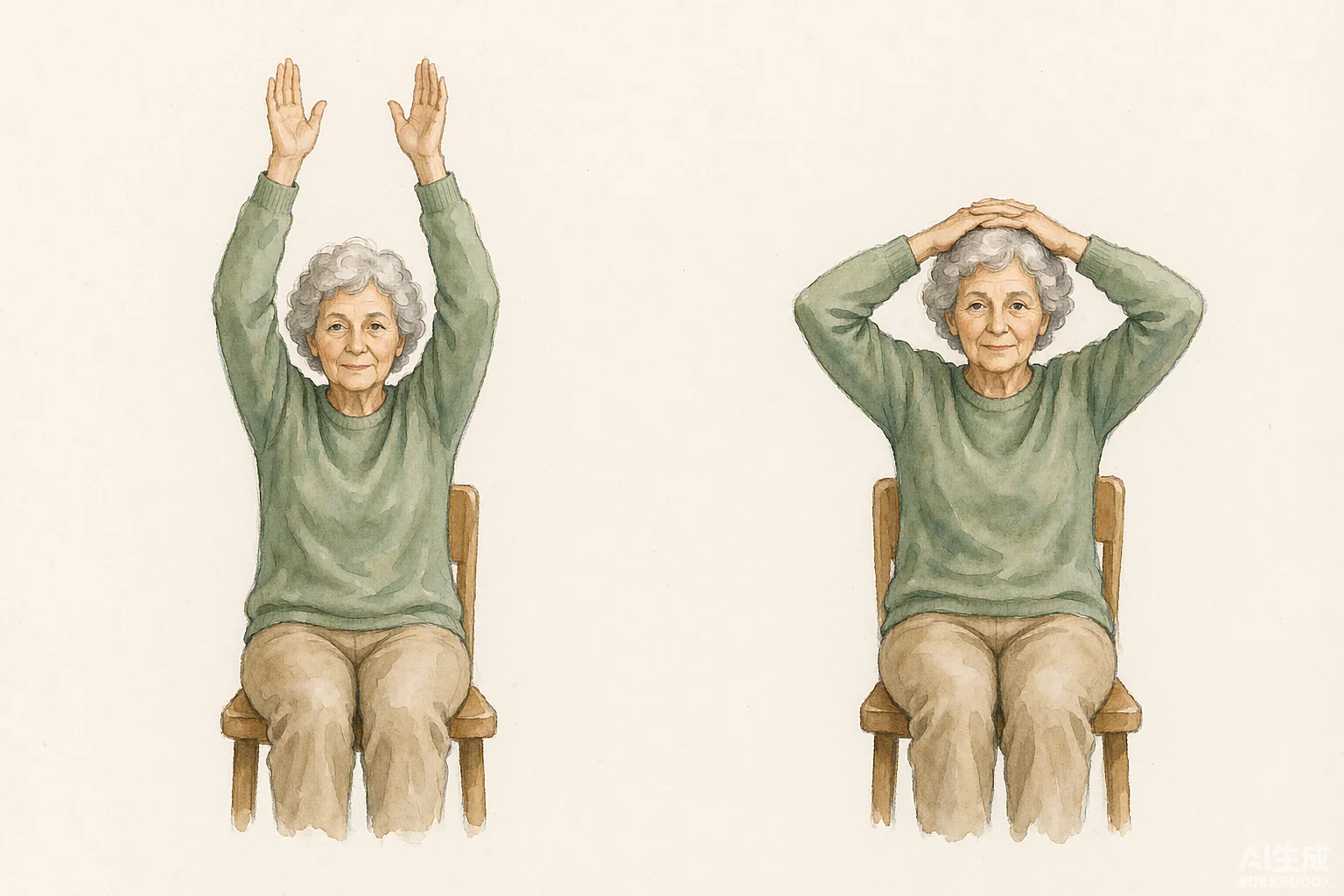
The same movement in two phases, in time with the breath. Up and down nine times.
- 1 Rotate the palms outward and press the joined hands straight up above the head, arms fully straight, spine long.
- 2 Turn the palms downward and rest them lightly on the crown, elbows opening out, shoulders staying down. This downward press is the second half of the figure and the reason it is not simply a lift.
How many
Nine rounds. One round is one press of the joined palms overhead and one press of the palms down onto the crown, and the ninth round ends on the downward press with the toes hooked. One full press — up and down — per breath.
Breath
The textbook sets no general breathing rule for this form, but it does call for holding the breath for a moment when the hands reach their highest point. Breathe through the nose at an even pace otherwise. If you have high blood pressure, heart disease, glaucoma, a tendency to dizziness, or simply prefer not to hold, keep breathing normally through that hold instead. Never strain when the hands bear down on the crown; keep the press as effort rather than force.
Common mistakes
- Letting the trunk lean or sag so the arms are no longer in line with it when the hands press upward.
- Starting with the hands already interlaced at the chest and skipping the set-up: lifting the elbows, sliding down the ribs, taking the knees and straightening the legs.
- Pressing up with the arms alone. The textbook's key point is that the roots of the palms drive up toward the crown of the head, which is what opens the inner channels of the arms and lengthens the whole back.
- Letting the arms drift away from the ears on the lift, or letting the elbows bend so the hands end up in front of the face rather than above the crown.
- Keeping the feet still through the nine rounds, instead of lengthening the tops of the feet on the upward press and hooking the toes on the downward press.
- Pressing on the crown so lightly that the movement becomes decorative; the official form asks for a press with some effort, while keeping it comfortable.
- Letting the shoulders ride up toward the ears instead of sinking them as the elbows bend and the hands come down.
- Arching the neck back at the top of the press. The gaze goes up toward the hands, but the neck stays long; the trunk and the arms keep one line.
- Holding the arms still at the top instead of settling for a moment before coming down.
- Bending the knees or letting them sag on the press up.
Take extra care if
- The textbook asks for a brief hold of the breath at the top of the lift. Do not hold your breath if you have high blood pressure, heart disease, glaucoma, a tendency to dizziness, or a neck problem — breathe normally and keep the pause without the hold.
- One teaching version has the eyes turned upward at the top; if that pulls on your neck, keep the gaze soft and forward.
- Breathe continuously and never strain: extend the feet only as far as is comfortable and stop at any cramp in the foot, calf or hamstring.
- Modification, not the official form: if straightening the knees brings pain behind the knee or in the lower back, keep both feet flat and work with the knees bent.
- Reduce the press on the crown, or rest the palms lightly instead, if you have neck problems, dizziness, or a history of cervical artery problems.
- Keep the arms lower, or work within a shorter range, if you have a shoulder injury or limited overhead reach.
Official English title of this form: Propping up the Sky and Pressing the Skull. The movement name is a traditional name, not a medical claim.
How to do it
The official form is practised sitting cross-legged on a firm wedge-shaped cushion with the front edge lower than the back. Every step below also says what to do if you are sitting in a chair — the two are the same movement, only the seat differs, so there is no separate version to choose between.
- Continuing from the previous form, lift both elbows up until they are level with the shoulders; look forward. In a chair: sit toward the front of a stable chair with both feet flat to begin with, and lift the elbows out and up until the forearms are level with the shoulders.
- Place the web between thumb and forefinger along the front of the shoulders, past the flanks, and slide both hands down along the ribs to the hip joints; look forward and down.
- Rotate both arms outward, set the palms against the outside of the legs at the knee joints, and lift upward under the knees; look forward and down. In a chair: carry the palms down the outside of the thighs to the knees and take hold under them, lifting slightly.
- Without stopping, extend the right leg forward, toes pointing upward, knee slightly bent; look at the right foot. In a chair: extend the right leg forward with the heel resting on the floor and the toes pointing up, knee slightly bent, then do the same with the left leg, resting both hands on top of the knees — extend only as far as the hamstrings comfortably allow. If you cannot extend both legs with the heels down, work one leg at a time for the whole set and keep the other foot flat.
- Extend the left foot forward so that both legs are drawn together and straight with the toes pointing up, and at the same time rest both palms on the knee joints; look at the toes.
- Draw both palms back to in front of the abdomen, facing each other, with the palms turned upward.
- Interlace all ten fingers; look forward and down.
- Raise the joined hands to the chest; as they arrive, rotate the arms inward and turn the palms over so that they face down.
- Carry the palms on forward, turn them outward and up, and when they are in front of the forehead with the palms facing up, press straight up with straight arms. At the same time straighten the knees and extend the tops of the feet so they are flat. Keep both arms close against the ears; look forward and down. In a chair: if you cannot extend a leg forward at all, keep both feet flat on the floor and give them the same job — as the hands press up, roll the weight onto the balls of the feet and lengthen the tops of the feet downward, away from you.
- Raise the arms as far as they will go and let the crown of the head press up into the hands, with the roots of the palms bearing toward the crown of the head, while the tops of the feet stay flat and extended. Hold the top position for a moment. Let the gaze follow the hands upward, but keep the neck long and do not let it arch back. In a chair: if raising both arms overhead is tiring, lower the hands only to eye height rather than stopping, and keep the same rhythm.
- Sink the shoulders and bend the elbows, turn the palms over and bring them down onto the crown of the head, pressing down with a little effort; at the same time hook both toes up tightly; look forward and down. In a chair: as the hands press down onto the crown, lift the toes and balls up hard toward the shin and keep the heels down. The pointing and the hooking alternate exactly as they do in the seated form, always opposing the hands, and the foot work is never dropped.
- Rotate the arms inward, turn the palms upward and press straight overhead with straight arms; at the same time straighten the knees and extend the tops of the feet; look forward and down.
- One press up together with one press down makes one round. Do nine rounds.
- After the ninth round, finish with the palms turned over and coming down onto the crown of the head, pressing down with a little effort while both toes hook up tightly; look forward and down.
If you are sitting in a chair
The differences worth knowing before you start — the substitutions are already written into each step above.
- The legs are not stretched out forward on a chair: either extend one leg at a time with the heel on the floor, or keep both feet flat and give them the same job — lengthening the tops of the feet on the press up, hooking the toes and balls on the press down.
- If raising both arms overhead is tiring, lower the hands to eye height rather than stopping, and keep the same rhythm.
Breathing and intention
The textbook sets no general breathing rule for this form, but it does call for holding the breath for a moment when the hands reach their highest point. Breathe through the nose at an even pace otherwise. If you have high blood pressure, heart disease, glaucoma, a tendency to dizziness, or simply prefer not to hold, keep breathing normally through that hold instead. Never strain when the hands bear down on the crown; keep the press as effort rather than force.
Common mistakes
- Letting the trunk lean or sag so the arms are no longer in line with it when the hands press upward.
- Starting with the hands already interlaced at the chest and skipping the set-up: lifting the elbows, sliding down the ribs, taking the knees and straightening the legs.
- Pressing up with the arms alone. The textbook's key point is that the roots of the palms drive up toward the crown of the head, which is what opens the inner channels of the arms and lengthens the whole back.
- Letting the arms drift away from the ears on the lift, or letting the elbows bend so the hands end up in front of the face rather than above the crown.
- Keeping the feet still through the nine rounds, instead of lengthening the tops of the feet on the upward press and hooking the toes on the downward press.
- Pressing on the crown so lightly that the movement becomes decorative; the official form asks for a press with some effort, while keeping it comfortable.
- Letting the shoulders ride up toward the ears instead of sinking them as the elbows bend and the hands come down.
- Arching the neck back at the top of the press. The gaze goes up toward the hands, but the neck stays long; the trunk and the arms keep one line.
- Holding the arms still at the top instead of settling for a moment before coming down.
- Bending the knees or letting them sag on the press up.
Before you start
- The textbook asks for a brief hold of the breath at the top of the lift. Do not hold your breath if you have high blood pressure, heart disease, glaucoma, a tendency to dizziness, or a neck problem — breathe normally and keep the pause without the hold.
- One teaching version has the eyes turned upward at the top; if that pulls on your neck, keep the gaze soft and forward.
- Breathe continuously and never strain: extend the feet only as far as is comfortable and stop at any cramp in the foot, calf or hamstring.
- Modification, not the official form: if straightening the knees brings pain behind the knee or in the lower back, keep both feet flat and work with the knees bent.
- Reduce the press on the crown, or rest the palms lightly instead, if you have neck problems, dizziness, or a history of cervical artery problems.
- Keep the arms lower, or work within a shorter range, if you have a shoulder injury or limited overhead reach.
Safety first
- Ask your doctor before starting if you have heart disease, uncontrolled blood pressure, dizziness or fainting, a fall in the last 6 months, surgery in the last 3 months, diagnosed osteoporosis, a hip or knee replacement, a painful joint, or pregnancy.
- Pain is a stop sign. Stop with burning, pressure or sharp pain; ordinary muscle tiredness is different from pain.
- For seated work use a sturdy, armless, wheel-free chair with a firm seat against a wall. Keep both feet flat, and use a stable book under the foot if you need it.
- For every standing or balance movement keep a fixed support within one arm's reach.
- Never hold your breath. Breathe with the movement, and return to normal breathing when the effort rises.
- If you feel dizzy, sit down, wait one minute, and end the session for that day.
- Drink water, practise at least one hour after a meal, and use non-slip shoes or a non-slip bare-foot surface.
- Use a comfortable range. Forward bends come from the hips with a long, neutral spine; avoid sudden twisting.
- This programme is not medical treatment and does not replace physiotherapy.
Where it comes from
Recorded in the old eight-figure set as "hands crossed, pressing upward on nothing", paired in the verse with the forward fold that follows it. The modern routine separates the two into their own forms and fixes the count at nine. Classical verse: 原典第9图属「两脚放舒伸,叉手双虚托」,对应的是托天按顶与俯身攀足两式的连做;本站把「低头攀足顿」另归第7式,故本式只取前半句。
The Twelve-Section Brocade is the modern official form of the seated Eight-Section Brocade, also called the literary eight-section brocade (wen baduanjin), which the Ming dynasty texts record in eight figures. Its name appears in the eighteenth-century Shoushi Chuanzhen, and the version in most circulation today comes from the Neigong Tushuo. It was standardised as an official routine in 2010 by the General Administration of Sport of China.
Sources
- Chinese Health Qigong Association, Health Qigong · Shi Er Duan Jin (routine overview)
- Zhang Hailing, Shi Er Duan Jin, Beijing Sport University Press, 2012 (ISBN 978-7-5644-1117-6) — a second independent source for the movement text, not the official textbook. Our own word-for-word transcription of its seated chapter is not filed in this repository, so the site cites the book rather than a page reference.
Common questions
Can I do Lift the Heavens and Press the Crown from a chair?
Yes. The official form is practised sitting cross-legged on a cushion, but this page gives a chair version that keeps the same movement while removing the need to get down onto the floor. Both versions are listed further down this page.
How many repetitions does Lift the Heavens and Press the Crown take?
Nine rounds. One round is one press of the joined palms overhead and one press of the palms down onto the crown, and the ninth round ends on the downward press with the toes hooked. The classical texts give their own counts, which are quoted on this page where they differ.
What does Lift the Heavens and Press the Crown involve?
It works mainly the spine, shoulders, arms, flanks, legs and ankles. In the traditional framing it belongs to the 托天按顶 principle; practically, it is a slow movement, self-massage or stillness practice depending on the form.
How long does Lift the Heavens and Press the Crown take?
About 1 minute. The pace is set by the breath rather than a timer, so slower is generally better.
Where does Lift the Heavens and Press the Crown come from?
Recorded in the old eight-figure set as "hands crossed, pressing upward on nothing", paired in the verse with the forward fold that follows it. The modern routine separates the two into their own forms and fixes the count at nine. Classical verse: 原典第9图属「两脚放舒伸,叉手双虚托」,对应的是托天按顶与俯身攀足两式的连做;本站把「低头攀足顿」另归第7式,故本式只取前半句。
When should I be careful with Lift the Heavens and Press the Crown?
The textbook asks for a brief hold of the breath at the top of the lift. Do not hold your breath if you have high blood pressure, heart disease, glaucoma, a tendency to dizziness, or a neck problem — breathe normally and keep the pause without the hold. One teaching version has the eyes turned upward at the top; if that pulls on your neck, keep the gaze soft and forward. Breathe continuously and never strain: extend the feet only as far as is comfortable and stop at any cramp in the foot, calf or hamstring. Modification, not the official form: if straightening the knees brings pain behind the knee or in the lower back, keep both feet flat and work with the knees bent. Reduce the press on the crown, or rest the palms lightly instead, if you have neck problems, dizziness, or a history of cervical artery problems. Keep the arms lower, or work within a shorter range, if you have a shoulder injury or limited overhead reach.
What else is Lift the Heavens and Press the Crown called?
In Chinese it is 托天按顶 (Tuō Tiān Àn Dǐng). The official English edition of the routine calls it "Propping up the Sky and Pressing the Skull". Descriptive English sources also use Support the Sky and Press the Head, Raise the Heavens, Press the Crown and Lifting the Sky and Pressing the Crown. It is the same movement in every case, and the classical verse line it belongs to reads "两脚放舒伸,叉手双虚托".
Written by LiHe — practitioner, teacher and consultant in qigong and traditional health practice. Review status and sources are shown below where available.
This is general movement education, not medical advice. It does not diagnose, treat or cure any condition. Read the full disclaimer.
The Chinese names are the traditional names of the movements. They are not medical claims, and this site does not diagnose, treat or cure any condition.
- Last reviewed
- Movement data
- Standing form follows the Chinese Fitness Qigong Association standard routine. The chair versions are this pack's own adaptation, written for a seated reader.. Version v0.5.
- Additional source
- The Twelve-Section Brocade is the routine promoted by the General Administration of Sport of China (2010). Step text follows Zhang Hailing, Shi Er Duan Jin (Beijing Sport University Press, 2012, ISBN 978-7-5644-1117-6). English form names follow the English edition of the routine (Foreign Languages Press, 2012, ISBN 9787119078717).