Two Hands Hold up the Heavens
两手托天理三焦 · Liǎng Shǒu Tuō Tiān Lǐ Sān Jiāo · Movement 01 of 8
Stand with feet shoulder-width apart and hands interlaced in front of the abdomen, palms up. Inhale as you raise both palms overhead, keeping the gaze on the hands the whole way, until the arms are straight and the palms reach above the crown of the head; then exhale as you separate the fingers and lower the hands along the sides of the body. Repeat one to three times. The movement lengthens the spine and opens the shoulders, and it is the easiest of the eight to adapt to a seated position.
- Works on
- shoulders, spine, chest
- Time
- 1 min
- Difficulty
- Gentle
- Seated version
- Yes
The standing version of Two Hands Hold up the Heavens
- Rotate both arms outward and lower the hands in front of the lower abdomen, palms facing up, the fingertips about 10 cm apart and the little-finger edge about 10 cm away from the lower abdomen.
- Spread the fingers of both hands and cross the hands in front of the lower abdomen.
- As the centre of gravity rises slowly, bend the elbows and lift both palms straight upward in front of the chest, palms facing up. When the hands reach chest height keep the eyes on the palms so that hands and eyes work together.
- Continue raising the palms as the knees straighten slowly; rotate both arms inward and press the palms up with the elbows slightly bent and the palms facing up. The eyes follow the hands and the chin lifts as the hands rise.
- Keep pressing the palms up until the elbows straighten, letting the arms continue to lengthen as the head returns to centre, then draw the chin in and look level ahead. Pause briefly with the arms held long. The 2018 correction text adds that the palms move to directly above the crown of the head with the arms held flush against the ears, and that the palms rise along the vertical line in front of the body, tilting forward only slightly once the arms are straight.
- Lower the centre of gravity slowly and bend the knees; before the palms separate, relax the shoulders and bend the elbows slightly, press down through the wrists and spread the fingers so the palms open slowly and easily, then lower the arms out to the sides of the body to about 45 degrees below horizontal, bend the elbows and cup both palms in front of the abdomen, palms facing up and fingertips about 10 cm apart.
Breathing
Inhale as the hands rise, exhale as they lower. The breath leads, the arms follow.
The seated version
This is the part most other guides leave out. If standing for a full round is difficult, uncomfortable or simply not something you want to do today, the movement still works from a chair.
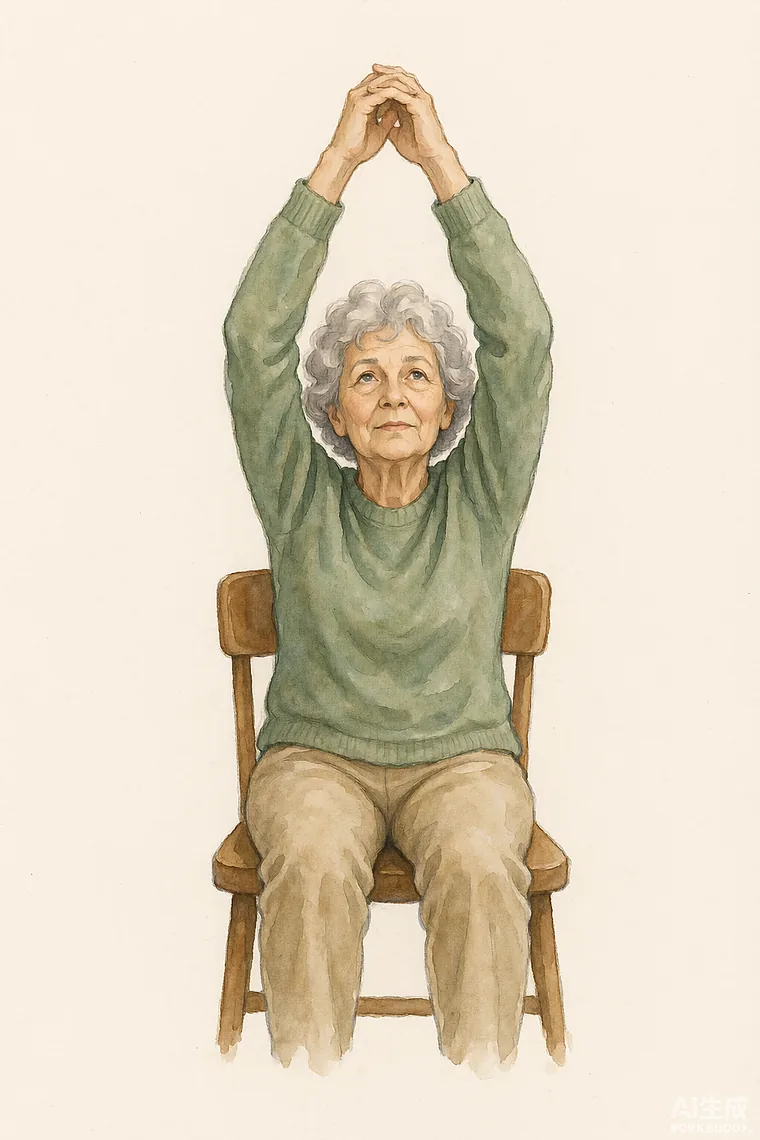
- From a chair, sit tall toward the front edge of a stable chair with both feet flat on the floor, and rotate both arms outward to lower the hands in front of the lower abdomen, palms facing up, the fingertips about 10 cm apart and the little-finger edge about 10 cm away from the lower abdomen. The starting hand position is the two palms held apart with the fingers spread; the hands are not woven together and the fingers are not laced.
- With the arms still down, spread the fingers of both hands and cross the hands in front of the lower abdomen so that the palms rest across one another with the fingers separated. On a chair the cross is made at the same height and in the same place as in the standing form.
- Inhale. Without leaving the chair, press both palms vertically upward in front of the chest, palms facing up. As the hands reach chest height keep the eyes on the palms so that hands and eyes work together, and from there let the eyes follow the hands all the way up.
- Continue raising both palms. The 2018 correction text for this form is explicit that looking up before the hands have risen is a fault, so raise the hands first and let the head come up with them. Lift the palms along the vertical line in front of the body and tilt forward only slightly once the arms are straight.
- Keep pressing the palms up until the elbows straighten, letting the arms continue to lengthen as the head returns to centre, then draw the chin in and look level ahead. Pause briefly with the arms held long. On a chair the palms can travel all the way to directly above the crown of the head with the arms held close to the ears; that is the standard end position and it is reachable without standing up. If you have a shoulder condition, rise only as far as the shoulder allows, and do not accept falling short of that line as the correct version.
- Exhale. Before the palms separate, relax the shoulders and bend the elbows slightly, press down through the wrists and spread the fingers so that the palms open slowly and easily; pulling them apart sharply is the fault this correction names. Then lower the arms out to the sides of the body to about 45 degrees below horizontal, bend the elbows and cup both palms in front of the abdomen, palms facing up, fingertips opposite each other about 10 cm apart.
- Repeat one to three times. Do not change this into raising one arm at a time; that is a different movement. If both arms tire before the set is finished, end the set and rest rather than alternating single arms.
Helpful cue
Interlace the fingers, press both palms up, then lower to the lap
Do not do this
- Shrugging the shoulders toward the ears at the top of the movement.
- Locking the elbows and holding the breath instead of continuing to breathe slowly.
- Looking up before the hands have risen, so that the head leads the movement instead of the hands.
- Letting the arms lean too far forward as the palms rise. Raise the palms along the vertical line in front of the body and tilt forward only slightly once the arms straighten.
- Stopping short of full extension. Keep straightening the elbows as the head returns to level so that the palms reach directly above the crown of the head with the arms flush against the ears.
- Pulling the palms apart sharply as they separate over the head. Before separating them, relax the shoulders and bend the elbows slightly, press down through the wrists, spread the fingers, and let the palms open slowly and easily.
- Rushing the descent instead of lowering the hands slowly at the same pace as the breath.
Who should take extra care
- Keep the movement within a comfortable range if you have shoulder impingement or a rotator cuff injury.
- Do not tip the head far back at the top if you have neck problems or dizziness.
Safety first
- Ask your doctor before starting if you have heart disease, uncontrolled blood pressure, dizziness or fainting, a fall in the last 6 months, surgery in the last 3 months, diagnosed osteoporosis, a hip or knee replacement, a painful joint, or pregnancy.
- Pain is a stop sign. Stop with burning, pressure or sharp pain; ordinary muscle tiredness is different from pain.
- For seated work use a sturdy, armless, wheel-free chair with a firm seat against a wall. Keep both feet flat, and use a stable book under the foot if you need it.
- For every standing or balance movement keep a fixed support within one arm's reach.
- Never hold your breath. Breathe with the movement, and return to normal breathing when the effort rises.
- If you feel dizzy, sit down, wait one minute, and end the session for that day.
- Drink water, practise at least one hour after a meal, and use non-slip shoes or a non-slip bare-foot surface.
- Use a comfortable range. Forward bends come from the hips with a long, neutral spine; avoid sudden twisting.
- This programme is not medical treatment and does not replace physiotherapy.
What the research says
A 12-week randomised study in older adults compared Baduanjin, Tai Chi Chuan and a health-education control group, and reported that both exercise groups improved mental control scores and showed changes in resting-state functional connectivity of the cognitive control network.
A separate 12-week imaging study reported increased grey matter volume in the insula, medial temporal lobe and putamen in both the Baduanjin and Tai Chi groups, alongside improved memory subscores.
Sources
- General Administration of Sport of China, Health Qigong Centre, Common Errors in Baduanjin and How to Correct Them (per form)
- Group standard for Baduanjin (Chinese Health Qigong Association / China Association of Chinese Medicine), graded movement breakdown — consulted via a government re-publication, 2026-06 (full citation not yet recorded)
- Tao et al., Tai Chi Chuan and Baduanjin Increase Grey Matter Volume in Older Adults, J Alzheimers Dis 2017;60(2):389-400
- Tao et al., Tai Chi Chuan and Baduanjin practice modulates functional connectivity, Sci Rep 2017;7:41581
Common questions
Can I do Two Hands Hold up the Heavens sitting down?
Yes. The seated adaptation keeps the shoulders, spine, chest work and removes the standing balance challenge. Both feet stay flat on the floor. The full seated steps are listed further down this page.
How long does Two Hands Hold up the Heavens take?
About 1 minute for one round at a slow pace. The quality of the movement matters more than the number of repetitions — move slowly enough that your breathing stays even and unforced.
What does Two Hands Hold up the Heavens work on?
It mainly involves the shoulders, spine, chest. In the traditional framing it belongs to the 两手托天理三焦 principle; practically, it is a slow mobilisation through that area rather than a strength exercise.
When should I be careful with Two Hands Hold up the Heavens?
Keep the movement within a comfortable range if you have shoulder impingement or a rotator cuff injury. Do not tip the head far back at the top if you have neck problems or dizziness.
What else is Two Hands Hold up the Heavens called?
In Chinese it is 两手托天理三焦 (Liǎng Shǒu Tuō Tiān Lǐ Sān Jiāo). English sources use Two Hands Hold up the Heavens, Raise Both Hands to the Sky, Two Hands Hold the Sky and Raise Palms to the Sky. The movement is the same in every case.
Written by LiHe — practitioner, teacher and consultant in qigong and traditional health practice. Review status and sources are shown below where available.
This is general movement education, not medical advice. It does not diagnose, treat or cure any condition. Read the full disclaimer.
The Chinese names are the traditional names of the movements. They are not medical claims, and this site does not diagnose, treat or cure any condition.
- Last reviewed
- Movement data
- Standing form follows the Chinese Fitness Qigong Association standard routine. The chair versions are this pack's own adaptation, written for a seated reader.. Version v0.5.